Kare Plastic Surgery & Skin Health Center · Los Angeles
Hyaluronidase to Dissolve Fillers
Los Angeles
Raffy Karamanoukian, MD, FACS
Dermal fillers can sometimes produce an undesired result such as asymmetry, excessive plumping, vascular occlusion emergency, or granuloma nodules, or filler migration. If these problems occur, Hyaluronidase enzyme can be used to dissolve the filler material. At Kare Plastic Surgery & Skin Health Center in Los Angeles, Dr. Raffy Karamanoukian utilizes his expertise to dissolve filler in a precise and surgically-relevant manner using ultrasound guidance.
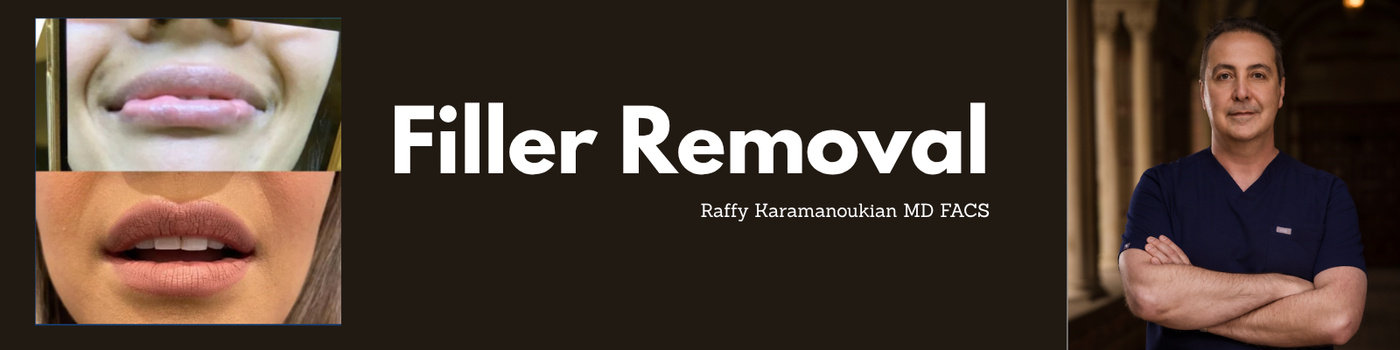
How Does Hyaluronidase Dissolve Dermal Fillers?
Hyaluronidase is an enzyme that chemically breaks down Hyaluronic acid fillers like Juvéderm, Restylane, Belotero, RHA, and Revanesse Versa. When injected directly into deposited HA filler, hyaluronidase enzymatically degrades the cross-linked hyaluronic acid matrix into smaller fragments that are then cleared through the body’s natural metabolic pathways within 24-48 hours.
Patients should be aware that Hyaluronidase dissolves only hyaluronic acid-based fillers. It has no direct effect on PMMA (Bellafill, Artefill, Artecoll), liquid silicone, Sculptra (poly-L-lactic acid), Radiesse (calcium hydroxylapatite), Bioplastique, Biopolimero, Dermagen, or any other non-HA permanent or semi-permanent filler. This distinctiion is where Dr. Karamanoukian's unique expertise comes to play, as he is a world-authority on the removal of permanent fillers.
24–48hTypical time for
hyaluronic acid fillers
to dissolve with hyaluronidase
UltrasoundDr. Karamanoukian uses
precise ultrasound to
locate filler deposits
EfficacyMost patients will see
a decrease in swelling
and volume within hours
Choosing Hyaluronidase to Dissolve Fillers
Vascular Occlusion — The Filler Emergency
The most urgent indication for hyaluronidase is vascular occlusion — the catastrophic complication in which HA filler is inadvertently injected into or compresses an artery supplying the skin or retina, cutting off blood flow and initiating an ischemic cascade that will produce irreversible skin necrosis or permanent vision loss if not treated immediately. Skin pallor, mottling, disproportionate pain, and blanching at the injection site are the early warning signs that demand immediate hyaluronidase injection at high doses — not tomorrow, not after the swelling subsides, but within minutes of recognizing the occlusion. Dr. Karamanoukian maintains hyaluronidase immediately available at every clinic day for precisely this emergency. Patients experiencing any signs of vascular compromise after filler injection should call (310) 998-5533 immediately.
Filler Emergency — Immediate Action Required: If you or your injector observe skin blanching, mottling, gray discoloration, or disproportionate pain immediately after a filler injection anywhere on the face, this is a vascular occlusion emergency. Call Kare Plastic Surgery immediately at (310) 998-5533. Time from occlusion to hyaluronidase treatment is the single most important determinant of whether skin necrosis or vision loss can be prevented.
Cosmetic Correction of Unwanted Dermal Fillers
Beyond emergencies, hyaluronidase is used electively for patients who are unhappy with prior HA filler results: excessive lip volume, Tyndall effect (bluish discoloration from superficially placed HA), tear trough overfill producing a puffy or hollow appearance, nasolabial fold overfill creating an unnatural shelf, cheek filler migration, or simply a result that does not match the patient’s aesthetic goals. Dr. Karamanoukian uses precise injection technique — depositing hyaluronidase directly adjacent to the HA deposit rather than diffusely flooding the tissue — to achieve selective dissolution of the problematic material while preserving desirable adjacent tissue volume.
Silicone Disease and PMMA Fillers
Hyaluronidase does not readily work on silicone disease and PMMA fillers such as Artefill, Artecoll, and Bellafill. However, Dr. Karamanoukian may use the enzyme to break up granuloma nodules that cause localized inflammation and lumpiness. His practice is one of a very small number in Los Angeles capable of managing the full spectrum of filler complications.
“Every filler complication patient who walks through the door gets the same first question: do we know for certain what was injected? The provenance of your filler injection will dictate the therapeutic steps we take to reduce inflammation and reduce filler volume.
— Dr. Raffy Karamanoukian, MD, FACS · Kare Plastic Surgery, Santa Monica
Why Choose Dr. Karamanoukian for Hyaluronidase Filler Dissolution in Los Angeles?
The clinical judgment required to use it safely, precisely, and in the correct clinical context sets our office apart from other clinicians attempting to use Hyaluronidase to reverse fillers. Our office utilizes ultrasound-guidance to precisely use filler reversal options that may include Hyaluronidase. We offer the clinical advantage of being treated by a surgeon whose expertise spans the full spectrum of filler complication management.
Related Resources at Kare Plastic Surgery
Kare Plastic Surgery & Skin Health Center · Santa Monica
Consultation Request
Schedule a consultation with Dr. Raffy Karamanoukian, a double board-certified plastic surgeon and world authority on dermal filler complications, hyaluronidase dissolution, silicone disease, and biopolymer removal in Los Angeles.