Kare Skin Health Center · Santa Monica & Los Angeles
Squamous Cell Skin Cancer Santa Monica
804 7th Street, Santa Monica, CA 90403 · Near Montana Avenue · (310) 998-5533
Dermatoscopic diagnosis, skin biopsy, SCC subtype identification, and plastic surgery reconstruction by board-certified dermatologist Dr. Tiffany Sierro and the Kare Skin Health Center team in Santa Monica
Call (310) 998-5533 Schedule a Skin Cancer Evaluation
BoardCertified Dermatologist
Dermatoscopic SCC Diagnosis
ActinicKeratosis Precursor Treatment
High RiskSCC Specialist
Squamous Cell Skin Cancer Santa Monica
Squamous Cell Carcinoma Can Spread. Early Diagnosis with Dr. Sierro Prevents That.
Dr. Tiffany Sierro, MD Board-Certified Dermatologist Dermatoscopic Diagnosis · SCC Subtype Identification · Skin Biopsy · Actinic Keratosis · High-Risk SCC Management · Kare Skin Health Center, Santa Monica
Squamous cell carcinoma is the second most common form of skin cancer in the United States, accounting for approximately 10 percent of all skin cancer cases. Unlike basal cell carcinoma, which very rarely spreads beyond the skin, squamous cell carcinoma has the capacity to invade surrounding tissue and spread to the lymph nodes and other organs if treatment is delayed. Squamous cell carcinoma of the skin is responsible for approximately 2,500 deaths each year in the United States. In Santa Monica, where cumulative sun exposure across a lifetime of outdoor living is among the highest in the country, squamous cell carcinoma is a skin cancer Dr. Sierro sees and treats regularly.
At Kare Skin Health Center at 804 7th Street in Santa Monica near Montana Avenue, board-certified dermatologist Dr. Tiffany Sierro, MD provides expert squamous cell carcinoma evaluation from the first suspicious lesion through definitive surgical treatment and post-treatment surveillance. She evaluates every lesion with dermatoscopy before biopsy, identifies the SCC subtype and risk level from pathology, and plans treatment based on the specific characteristics of each case. Patients who require excision in a cosmetically sensitive area benefit from Kare's integrated model — Dr. Sierro working alongside a dual board-certified plastic surgeon in the same practice for coordinated reconstruction without referral delays.
10%Of all skin cancers are squamous cell carcinoma
2,500Deaths from SCC each year in the US
80%Of lifetime sun exposure acquired before age 20
CanSpread to lymph nodes if untreated
Squamous Cell Skin Cancer Services at Kare Skin Health Center Santa Monica
- Annual skin cancer screening for SCC and actinic keratosis detection
- Dermatoscopic evaluation of rough, scaly, or non-healing lesions
- Skin biopsy with SCC subtype confirmation by pathology
- Surgical excision with margin clearance for primary SCC
- Actinic keratosis treatment to prevent SCC development
- Topical 5-fluorouracil (Efudex) for superficial SCC and actinic keratosis
- Photodynamic therapy with Levulan for field cancerization
- Plastic surgery reconstruction for facial, lip, ear, and scalp SCC
- High-risk SCC management with sentinel lymph node evaluation referral
- Post-excision surveillance with scheduled follow-up for SCC recurrence monitoring
Kare Skin Health Center · Santa Monica · Near Montana Avenue
Schedule a squamous cell carcinoma evaluation with Dr. Sierro.
Clinical Case — Kare Skin Health Center, Santa Monica · Dr. Tiffany Sierro
Invasive Squamous Cell Carcinoma
Clinical documentation · Kare Skin Health Center, Santa Monica · Invasive SCC requiring surgical excision with clear margins
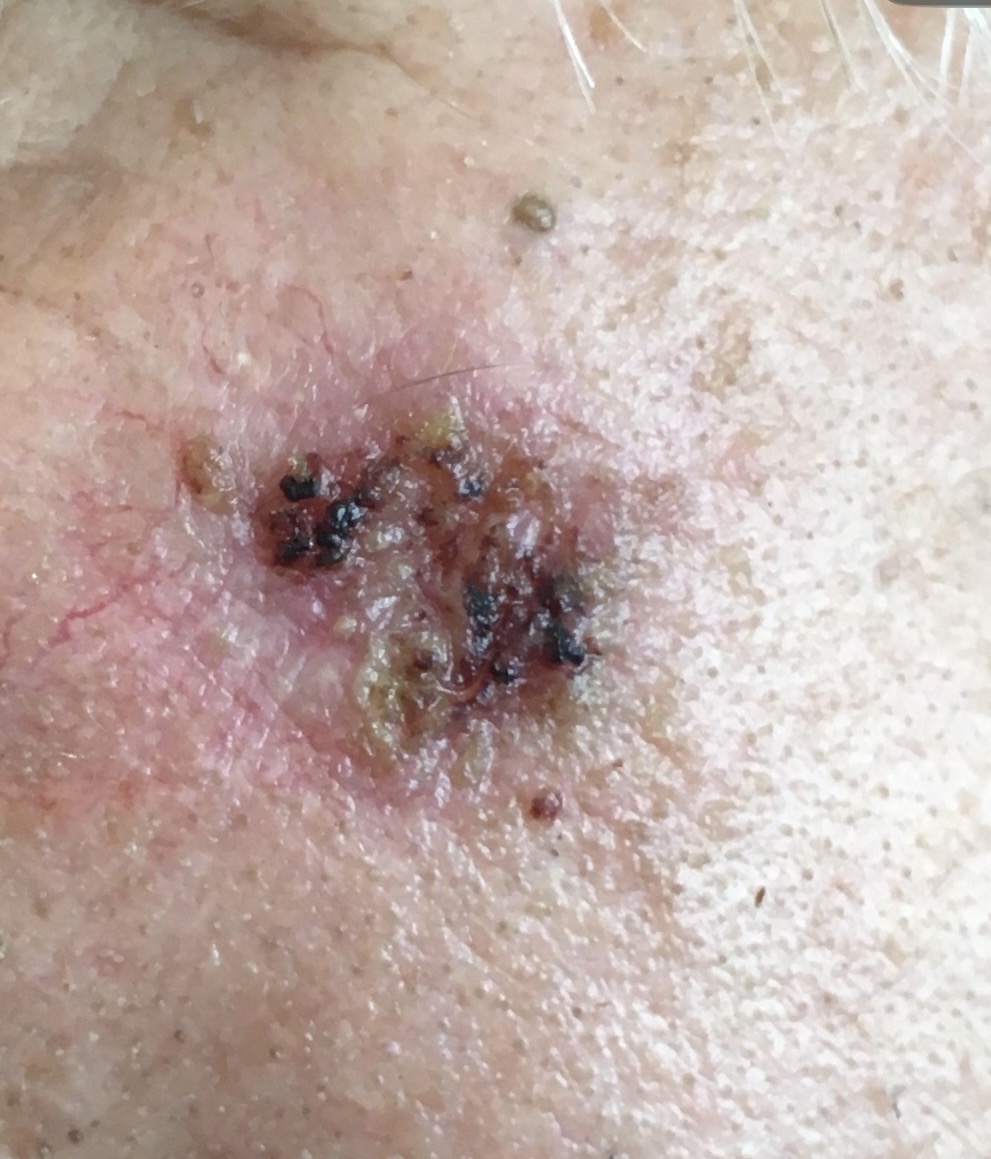
Invasive Squamous Cell Carcinoma — Clinical Documentation · Kare Skin Health Center
What This Image Shows
This close-up clinical photograph documents an invasive squamous cell carcinoma. The central lesion shows ulceration with dark hemorrhagic crust and keratinaceous debris — the result of the cancer outgrowing its blood supply and breaking down at the surface. The surrounding skin shows an erythematous, indurated base with irregular borders and radiating telangiectatic vessels, all within a field of chronically sun-damaged skin. This is the classic appearance of invasive SCC that has grown beyond the superficial epidermal layer and requires surgical excision with clear margin confirmation.
Why This Should Not Be Waited On
Patients sometimes wait months before seeking evaluation of a lesion that looks like this, assuming it is a wound or an infection that will resolve on its own. Squamous cell carcinoma does not resolve. The central ulceration and crust visible in this image are characteristic of a tumor that is actively growing and breaking down tissue. Every week of delay allows the cancer to grow deeper, increasing the size of the surgical excision required and the complexity of the reconstruction. Call Dr. Sierro at Kare Skin Health Center for prompt evaluation. Call (310) 998-5533.
The Kare Treatment Pathway
A lesion presenting like the one above is evaluated with dermatoscopy at the first visit, biopsied under local anesthesia, and the pathology results are reviewed with the patient at the biopsy result visit. Dr. Sierro determines the SCC subtype, depth of invasion, and risk level from the biopsy report and recommends a specific excision margin and reconstruction plan. For cosmetically sensitive locations, the Kare plastic surgery team performs reconstruction in the same practice on the same treatment plan.
Close-up clinical documentation of invasive squamous cell carcinoma at Kare Skin Health Center, Santa Monica — showing central ulceration with hemorrhagic crust, keratinaceous debris, surrounding erythematous indurated base, and telangiectatic vessels on chronically sun-damaged skin. This type of lesion requires prompt evaluation, biopsy, and surgical excision with clear margin confirmation. Dr. Tiffany Sierro · Kare Skin Health Center, Santa Monica. Individual results may vary.
Recognizing Squamous Cell Carcinoma
How Squamous Cell Carcinoma Appears — From Actinic Keratosis to Invasive SCC
Squamous cell carcinoma develops in the squamous cells that make up the outer layer of the skin. Most SCC follows a progression that begins with actinic keratosis, a sun-damaged precancerous lesion, and advances to superficial then invasive SCC if not treated. Recognizing the full spectrum of this progression is what allows Dr. Sierro to intervene before an actinic keratosis becomes an invasive cancer — and to treat invasive SCC at the earliest possible stage when excision is simplest and most complete.
Actinic Keratosis
The most common SCC precursor. Appears as a rough, scaly, sandpaper-textured patch on sun-exposed skin. May feel tender when rubbed. Flesh-colored, pink, or red. Approximately 10 percent of untreated actinic keratoses progress to invasive SCC over 10 years. Treatment of actinic keratoses is SCC prevention.
Squamous Cell Carcinoma In Situ (Bowen Disease)
SCC confined to the outer layers of the skin without invasion of the dermis. Appears as a flat, red, scaly or crusty plaque that grows slowly over time. Fully curable when treated at this stage. Can be treated with topical therapy, curettage, or superficial excision.
Invasive Squamous Cell Carcinoma
SCC that has grown into the dermis. Appears as a firm bump, an indurated plaque, or a non-healing ulcer with a raised border and central crusting. Can bleed without trauma. This stage requires surgical excision with adequate margins. High-risk invasive SCC may require sentinel lymph node evaluation.
Keratoacanthoma
A rapidly growing dome-shaped tumor with a keratin-filled crater that resembles SCC histologically and clinically. Previously considered benign but now treated as a low-grade SCC. Dr. Sierro evaluates keratoacanthoma carefully and recommends excision rather than watchful waiting for lesions on cosmetically sensitive areas.
Verrucous Carcinoma
A well-differentiated, slowly growing, warty form of SCC with a cauliflower-like surface. Less aggressive than conventional SCC and rarely spreads to lymph nodes but grows locally and can invade deep structures. Requires complete surgical excision for cure.
SCC in Chronic Wounds
Marjolin ulcer — SCC arising in a chronic wound, burn scar, or radiation-treated skin. This SCC subtype is particularly aggressive and has a higher rate of lymph node spread than SCC arising in normal sun-damaged skin. Dr. Sierro identifies this high-risk feature at biopsy and manages these cases with wider excision margins and closer follow-up.
Who Is at Risk for Squamous Cell Carcinoma in Santa Monica
Sun Exposure History
Cumulative sun exposure over a lifetime is the primary driver of SCC. About 80 percent of lifetime sun exposure is acquired before the age of 20. Santa Monica patients who grew up active outdoors in the Southern California sun carry the highest cumulative UV exposure burden in the country. Annual skin screening is essential for this population.
Fair Skin and Easy Sunburn
Patients with fair skin, light hair, and light eyes have less natural UV protection and are at highest risk for SCC. However, any skin type can develop squamous cell carcinoma with sufficient UV exposure, particularly patients with a history of significant tanning or outdoor work over many years.
Immunosuppression
Organ transplant recipients are at dramatically elevated risk for SCC — up to 65 times higher than the general population. Other immunosuppressed patients including those on long-term steroids or biologic therapies also have elevated SCC risk and more aggressive disease behavior. Immunosuppressed patients should be screened every 6 months rather than annually.
Prior Radiation, Chronic Ulcers, and Burns
SCC that arises in radiation-treated skin, chronic wounds, or old burn scars behaves more aggressively than UV-related SCC. These cases have higher rates of incomplete treatment and lymph node spread. Dr. Sierro identifies SCC arising in these settings at biopsy and adjusts the treatment plan to account for the elevated risk.
Treatment Options for Squamous Cell Carcinoma at Kare Skin Health Center
Surgical Excision
The primary treatment for most invasive SCC. The tumor is removed with a surrounding margin of normal tissue to ensure complete clearance. Margin confirmation by pathology is performed before reconstruction begins on cosmetically sensitive sites. Excision achieves cure rates above 92 percent for primary low-risk SCC.
Curettage and Electrodesiccation
Appropriate for superficial, well-differentiated SCC on the trunk and extremities. The tumor is scraped away with a curette and the base destroyed with an electric current. Not recommended for invasive SCC, high-risk sites including the face and ears, or in immunosuppressed patients.
Topical 5-Fluorouracil and Imiquimod
Topical Efudex (5-FU) and imiquimod are used for SCC in situ (Bowen disease) and actinic keratosis field treatment. They are not appropriate for invasive SCC. Dr. Sierro uses these agents for patients with widespread actinic keratosis or SCC in situ who are not candidates for surgery on the affected area.
Photodynamic Therapy
Photodynamic therapy with Levulan (aminolevulinic acid) treats actinic keratosis and superficial SCC by applying a photosensitizing cream to the skin and then exposing it to a specific wavelength of light that activates the drug and kills the cancer cells. Particularly useful for patients with large areas of actinic damage on the face or scalp.
Plastic Surgery Reconstruction
SCC excision on the face, lip, ear, nose, or scalp often requires reconstruction of the resulting defect. The Kare Skin Health Center coordinates directly with the Kare plastic surgery team in the same practice — the same standard of care, no referral delay, and seamless coordination from biopsy through reconstruction and surveillance.
Post-Treatment Surveillance
After SCC treatment, patients require ongoing surveillance for local recurrence and new primary SCC. Dr. Sierro schedules post-treatment follow-up visits at 3 months, 6 months, and then annually. Immunosuppressed patients and patients with high-risk SCC are followed every 6 months. SCC recurrence is most likely within the first 2 years after treatment.
Actinic keratosis treatment is SCC prevention. Approximately 10 percent of actinic keratoses will progress to invasive SCC over time if left untreated. Patients with widespread actinic keratoses on the face, scalp, or forearms should discuss field treatment with Dr. Sierro — whether that is topical 5-fluorouracil, imiquimod, or photodynamic therapy — to reduce the number of actinic keratoses present and reduce the overall SCC risk. This is one of the most effective and underutilized cancer prevention interventions in dermatology.
"Squamous cell carcinomas can occur rapidly on the skin or develop over time. Dermatology acumen is essential in diagnosing this type of skin cancer."
Kare Skin Health Center, Santa Monica
Authority Resources at Kare Skin Health Center
Frequently Asked Questions
Where can I get squamous cell skin cancer treated in Santa Monica?
Kare Skin Health Center at 804 7th Street in Santa Monica near Montana Avenue offers expert squamous cell carcinoma diagnosis and treatment by board-certified dermatologist Dr. Tiffany Sierro. Dermatoscopic evaluation, skin biopsy, SCC subtype identification, surgical excision, actinic keratosis treatment, and plastic surgery reconstruction for cosmetically sensitive sites. Call (310) 998-5533. We serve patients from Santa Monica, Beverly Hills, Brentwood, Malibu, and all of Los Angeles.
What is the difference between squamous cell carcinoma and basal cell carcinoma?
Basal cell carcinoma is the most common skin cancer and very rarely spreads beyond the skin. Squamous cell carcinoma is the second most common skin cancer and is more dangerous because it has the ability to spread to the lymph nodes and other organs if treatment is delayed. SCC on the lips and ears carries the highest spread risk. Both cancers are primarily caused by cumulative UV exposure and are treated with surgical excision. SCC requires wider excision margins and closer post-treatment surveillance than most BCC cases. Dr. Sierro at Kare Skin Health Center manages both cancers and can advise on the specific risk level and appropriate treatment for your individual case. Call (310) 998-5533.
How can I prevent squamous cell carcinoma in Santa Monica?
The most effective SCC prevention strategies are daily broad-spectrum sunscreen use with SPF 30 or higher, avoiding peak sun hours between 10am and 4pm, wearing protective clothing and broad-brim hats outdoors, and having an annual full body skin exam with Dr. Sierro at Kare Skin Health Center. Because 80 percent of lifetime sun exposure is acquired before age 20, adults who grew up in Southern California carry a significant cumulative UV burden that makes annual skin screening particularly important. Treating actinic keratoses promptly when Dr. Sierro identifies them at your annual exam is one of the most direct ways to prevent them from progressing to SCC. Call (310) 998-5533.
Related Resources at Kare Skin Health Center
Kare Skin Health Center · Santa Monica · Near Montana Avenue
Schedule a Skin Cancer Evaluation
Dr. Tiffany Sierro, board-certified dermatologist at Kare Skin Health Center in Santa Monica, provides expert squamous cell skin cancer evaluation, actinic keratosis treatment, surgical excision, and coordinated plastic surgery reconstruction in the same practice — for patients across Santa Monica and Los Angeles.