Kare Plastic Surgery · Los Angeles & Santa Monica
Facelift Scar Revision Los Angeles
804 7th Street, Santa Monica, CA 90403 · (310) 998-5533
Thick, wide, hypertrophic, and visible facelift scar revision — surgical re-excision, steroid injection, laser, and scar management by board-certified plastic surgeon Dr. Raffy Karamanoukian at Kare Plastic Surgery
Call (310) 998-5533 Schedule a Scar Revision Consultation
BoardCertified Plastic Surgeon
FaceliftScar Specialist
Facelift Scar Revision Los Angeles
A Visible Facelift Scar Signals Prior Surgery to Everyone. It Doesn't Have to.
Dr. Raffy Karamanoukian, MD FACS Board-Certified Plastic Surgeon Facelift Scar Revision · Hypertrophic Scar · Surgical Re-Excision · Steroid Injection · Laser · Kare Plastic Surgery, Los Angeles
A successful facelift should be invisible. The hallmark of expert facelift technique is that no one can tell — the incisions are hidden within the natural contours of the ear, hairline, and posterior auricular sulcus, and the scars heal flat, pale, and imperceptible. When a facelift scar becomes visible — whether from excessive wound tension, hypertrophic thickening, misplacement, or poor wound healing — it defeats the entire purpose of the procedure, drawing attention to exactly what the surgery was meant to conceal.
At Kare Plastic Surgery, board-certified plastic surgeon Dr. Raffy Karamanoukian, MD FACS evaluates and revises facelift scars with precision. His extensive experience in facelift surgery is combined with his specialist knowledge of facial scar anatomy, scar physiology, and the full spectrum of scar revision techniques.
Facelift Scar Revision Services at Kare Plastic Surgery
- Surgical facelift scar re-excision — preauricular, postauricular, and temporal
- Hypertrophic scar injection — intralesional triamcinolone series
- Laser scar treatment — pulsed dye laser and fractional CO2
- Keloid scar excision and steroid/radiation combination therapy
- Widened facelift scar revision — tension-reducing re-closure
- Hairline scar revision — temporal and occipital incision revision
- Silicone sheeting and scar management protocols
- Scar assessment and individualized revision planning consultation
Kare Plastic Surgery · Los Angeles · (310) 998-5533
Thick, wide, or visible facelift scar? Schedule a facelift scar revision consultation with Dr. Karamanoukian today.
Clinical Documentation — Kare Plastic Surgery · Dr. Raffy Karamanoukian
Thick Facelift Scar — The Type of Scar Dr. Karamanoukian Treats
Patient presenting to Kare Plastic Surgery · Thick, hypertrophic scar tissue at the postauricular and periauricular facelift incision · Evaluated for multimodal scar revision by Dr. Karamanoukian
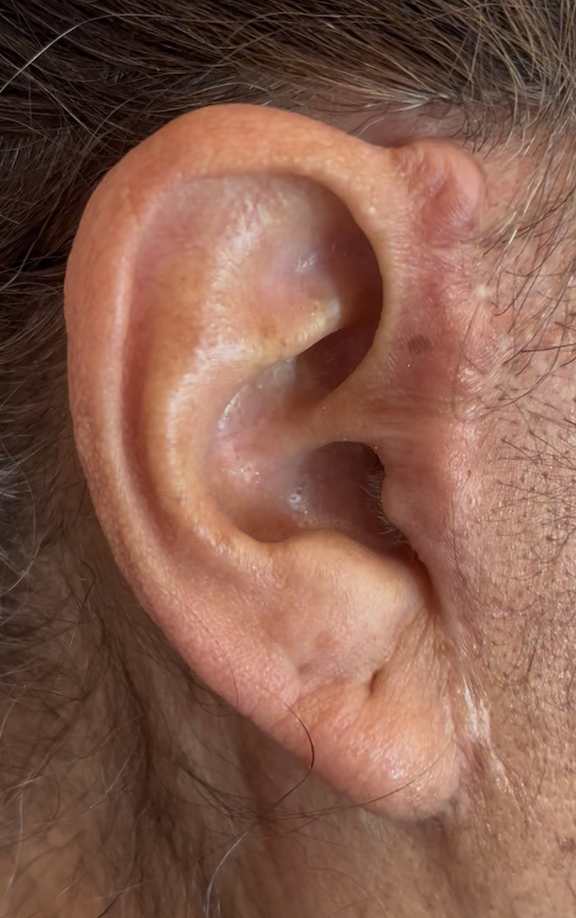
Thick Hypertrophic Facelift Scar · Kare Plastic Surgery · Dr. Karamanoukian, Los Angeles Significant postauricular and periauricular scar thickening following prior facelift · Raised hypertrophic tissue · Evaluated for multimodal scar revision including steroid injection series, laser treatment, and surgical re-excision
The Scar
This patient presents with thick, raised, hypertrophic scar tissue at the periauricular and postauricular facelift incision sites — a pattern of abnormal collagen deposition characteristic of high-tension wound closure. The thickening is most prominent in the postauricular sulcus, where wound closure tension is typically highest during facelift surgery. The scar architecture is disorganized and elevated, creating a visible deformity that draws attention to the prior surgery.
Dr. Karamanoukian's Assessment
Dr. Karamanoukian evaluates every facelift scar with particular attention to the underlying cause — tension, hematoma history, infection, genetic predisposition — because the cause determines the treatment strategy. A hypertrophic scar from wound tension is approached differently from a genetic keloid former. Addressing the cause, not just the visible scar, is what determines whether revision produces a lasting improvement or a recurrence.
Treatment Plan
This patient's hypertrophic facelift scar was treated with a series of intralesional triamcinolone acetonide injections to reduce scar volume and pliability before surgical re-excision. Following revision surgery with tension-eliminating deep suture placement and fine surface closure, a pulsed dye laser series was initiated to address residual scar erythema and further improve scar quality. Long-term silicone therapy and sun protection were maintained throughout healing.
Types of Facelift Scars Dr. Karamanoukian Revises
Facelift Scar Problems Dr. Karamanoukian Treats in Los Angeles
Hypertrophic Scar
Thick, raised, firm scar tissue confined to the incision boundary — the most common facelift scar problem. Caused by excessive wound tension or individual healing predisposition. Responds to intralesional steroid injection series and, when mature, surgical re-excision with tension-eliminating closure.
Wide / Stretched Scar
A flat but widened scar — most commonly in the postauricular sulcus or temporal hairline — resulting from incision placement under excessive tension. Widened scars remain flat but become visible as pale or discolored bands. Surgical re-excision with layered tension-eliminating closure narrows the scar significantly.
Displaced Incision
A facelift incision placed in the wrong anatomical location — too far anterior along the preauricular area, through visible hair-bearing skin, or along an unnatural contour. Displaced incision scars require careful re-excision and repositioning to place the revised scar within anatomically natural boundaries where it is less visible.
Hairline Scar
Visible scars along the temporal or occipital hairline from facelift incisions — presenting as hairless bands where the hair follicles were damaged during the original surgery. Hairline scar revision must address both the scar and any alopecia, using follicular unit grafting or scalp advancement to restore the natural hairline transition.
Keloid Scar
A keloid grows beyond the original incision boundary — most commonly behind the ear — and can be significantly raised, firm, tender, and cosmetically distressing. Keloid revision after facelift requires a combined approach of surgical excision, perioperative intralesional steroid, and potentially adjuvant low-dose radiation therapy to minimize the risk of recurrence.
Postauricular Scar
The most common location for problematic facelift scarring — the posterior auricular sulcus and retroauricular skin behind the ear. This zone experiences high wound closure tension in virtually all facelift designs and is disproportionately prone to hypertrophic scar formation. Dr. Karamanoukian has extensive experience revising scars in this specific anatomical zone.
Facelift Scar Revision Treatment Options at Kare Plastic Surgery
Intralesional Steroid Injection
Triamcinolone acetonide injected directly into the hypertrophic scar tissue is the first-line treatment for raised, firm facelift scars — and can be initiated as early as 6–8 weeks after the original facelift. The steroid reduces collagen synthesis within the scar, progressively flattening and softening the raised tissue over a series of injections spaced 4–6 weeks apart. Dr. Karamanoukian calibrates concentration (typically 10–40 mg/mL) to the scar thickness and monitors for steroid atrophy at each treatment visit.
Surgical Scar Re-Excision
For mature, stable facelift scars that have not responded adequately to steroid injection — typically at 9–12 months post-facelift — surgical re-excision with tension-eliminating deep suture placement is the definitive revision approach. Dr. Karamanoukian excises the entire scar, eliminates residual wound tension with deep absorbable sutures, and closes the surface with fine monofilament for the narrowest possible revised scar line. The re-excision is designed to avoid repeating the conditions that caused the original scar problem.
Pulsed Dye Laser (PDL)
Vbeam pulsed dye laser targets the oxyhemoglobin in the blood vessels supplying the hypertrophic scar — reducing redness, vascularity, and the pro-fibrotic signaling that drives continued scar thickening. PDL is most effective for erythematous (red) hypertrophic facelift scars in the early to mid maturation phase and can be combined with steroid injection at the same visit for a synergistic effect. Multiple sessions at 4–6 week intervals are typically required.
Fractional CO2 Laser
Fractional CO2 laser resurfacing — applied to mature, flat but textured or discolored facelift scars — remodels the scar collagen architecture, improving surface texture, blending scar color with surrounding skin, and stimulating organized collagen reorganization. Dr. Karamanoukian uses fractional CO2 for facelift scars that are flat but remain visible due to textural or pigmentary differences with the surrounding facial skin — a problem that surgical revision alone cannot address.
Timing matters: The ideal timing for facelift scar revision depends on the scar type. Steroid injections can begin as early as 6–8 weeks for hypertrophic scars. Surgical re-excision is typically most effective after 9–12 months of scar maturation, when the surrounding tissue is fully healed and the scar is at its most stable and amenable to revision. Dr. Karamanoukian evaluates each facelift scar individually and designs a revision timeline tailored to the patient's specific scar biology and goals. Call (310) 998-5533.
"A facelift scar problem almost always comes down to tension — too much tension across the skin closure. The revision has to address that tension directly, not just excise the scar and close the same way. Otherwise you're repeating the same mistake and expecting a different result."
— Dr. Raffy Karamanoukian, MD FACS · Board-Certified Plastic Surgeon · Kare Plastic Surgery, Los Angeles
Frequently Asked Questions
Can facelift scars be revised in Los Angeles?
Yes. Dr. Raffy Karamanoukian at Kare Plastic Surgery specializes in facelift scar revision — improving wide, thick, hypertrophic, displaced, and visible facelift scars through surgical re-excision, steroid injection, laser treatment, and comprehensive scar management. Call (310) 998-5533 to schedule a consultation.
When is the best time to revise a facelift scar?
Steroid injection for hypertrophic scars can begin at 6–8 weeks post-facelift. Surgical re-excision is typically recommended after 9–12 months once the scar is fully mature. Dr. Karamanoukian evaluates each scar individually and recommends the optimal timing and technique. Call (310) 998-5533.
What causes a thick or wide scar after a facelift?
Thick and wide facelift scars most commonly result from excessive wound closure tension — when the skin is advanced too aggressively and bears more tension than the healing tissue can tolerate. Other factors include hematoma, infection, genetic predisposition, and smoking. Dr. Karamanoukian addresses both the scar and the underlying cause during revision to reduce recurrence risk. Call (310) 998-5533.
Schedule Your Facelift Scar Revision Consultation
Kare Plastic Surgery · Los Angeles & Santa Monica · 804 7th Street
Revise Your Facelift Scar with Dr. Karamanoukian
Dr. Raffy Karamanoukian, board-certified plastic surgeon at Kare Plastic Surgery, provides expert facelift scar revision throughout the Los Angeles area — surgical re-excision, steroid injection series, pulsed dye laser, and fractional CO2 for every type of facelift scar problem. Individualized revision planning. Meticulous technique. Same-week consultation appointments available.