Kare Plastic Surgery · Los Angeles & Santa Monica
Bio-Alcamid Filler Removal
Los Angeles
804 7th Street, Santa Monica, CA 90403 · (310) 998-5533
Polyalkylamide permanent filler extraction using ultrasound-guided aspiration and surgical removal of Bio-Alcamid from the face by board-certified plastic surgeon Dr. Raffy Karamanoukian at Kare Plastic Surgery
Call (310) 998-5533 Schedule a Consultation
BoardCertified Plastic Surgeon
Bio-AlcamidRemoval Specialist
Bio-Alcamid Removal Los Angeles
Bio-Alcamid Cannot Be Dissolved. It Must Be Surgically Removed by a Surgeon with Expertise
Dr. Raffy Karamanoukian, MD FACS Board-Certified Plastic Surgeon Bio-Alcamid Removal · Polyalkylamide Extraction · Permanent Filler Removal · Ultrasound-Guided Technique · Kare Plastic Surgery, Los Angeles
Bio-Alcamid (polyalkylamide gel) is a synthetic permanent filler that was widely used for facial augmentation for cheek, chin, and jaw contouring and HIV-related facial lipoatrophy in Europe, Latin America, and parts of Asia throughout the early 2000s. It is not FDA-approved and not legally available in the United States. Many patients who received Bio-Alcamid injections abroad are now experiencing the delayed complications that were documented in medical literature within years of the material's widespread use: capsule rupture, material migration, infection, granuloma formation, and progressive facial deformity that is unresponsive to any non-surgical treatment.
At Kare Plastic Surgery, Dr. Raffy Karamanoukian, MD FACS offers one of the most comprehensive Bio-Alcamid and permanent filler removal programs in the Los Angeles area.
If you have received Bio-Alcamid or any permanent filler injection and are experiencing new swelling, firmness, pain, redness, or deformity: seek evaluation promptly. Infected Bio-Alcamid pseudo-capsules require urgent drainage and antibiotic therapy before definitive surgical removal. Do not have additional fillers or procedures at the site until the Bio-Alcamid has been fully assessed and removed. Call Dr. Karamanoukian at (310) 998-5533 for an urgent evaluation.
Kare Plastic Surgery · Los Angeles · (310) 998-5533
Bio-Alcamid in your face causing problems? Schedule a permanent filler removal consultation with Dr. Karamanoukian today.
Clinical Documentation — Kare Plastic Surgery · Dr. Raffy Karamanoukian
Bio-Alcamid Polyalkylamide Filler — Clinical Assessment at Kare Plastic Surgery
Actual patient at Kare Plastic Surgery · Bio-Alcamid polyalkylamide filler deposits in the face assessed by Dr. Raffy Karamanoukian · Pre-operative evaluation for extraction planning
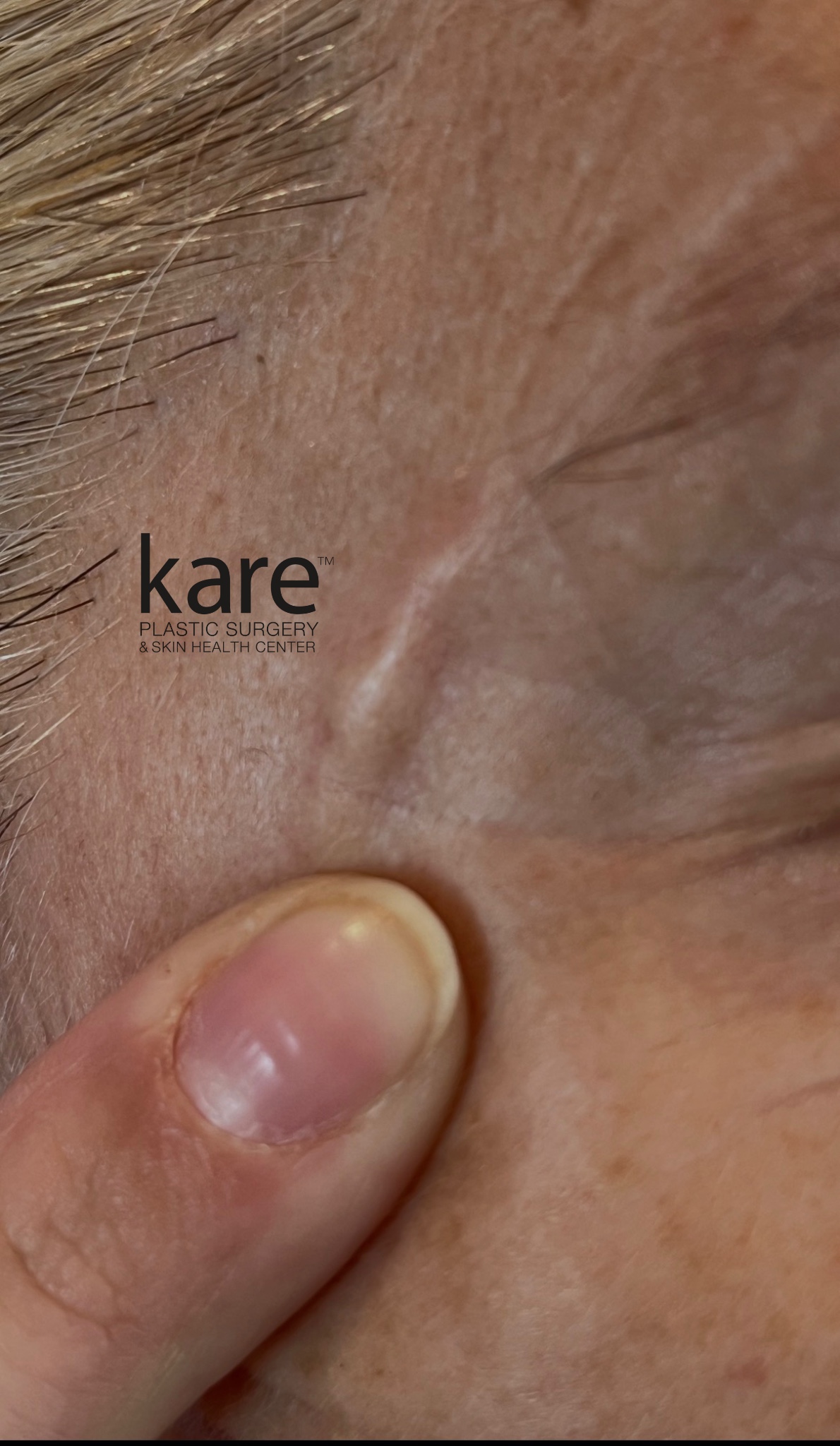 Bio-Alcamid Filler Assessment · Kare Plastic Surgery · Dr. Karamanoukian, Los Angeles Palpable subcutaneous Bio-Alcamid polyalkylamide pseudo-capsule · Pre-operative assessment for ultrasound-guided aspiration or surgical extraction · Evaluated with diagnostic ultrasound before procedure planning
What You're Seeing
The raised, smooth subcutaneous irregularity visible in this patient represents an intact Bio-Alcamid pseudo-capsule — the fibrous capsule that forms around the polyalkylamide gel deposit. When the capsule remains intact, the material may be aspirated through a fine cannula with irrigation under ultrasound guidance. When the capsule has ruptured or fragmented, open surgical extraction is required.
Ultrasound First
Dr. Karamanoukian performs diagnostic ultrasound imaging on every Bio-Alcamid patient before surgery — mapping the precise location, depth, volume, and capsule integrity of each deposit. This pre-operative imaging determines whether aspiration or open extraction is appropriate and guides the surgical approach to minimize tissue disruption and maximize material removal completeness.
Extraction Strategy
For intact, accessible deposits identified on ultrasound, Dr. Karamanoukian performs irrigation-aspiration extraction under local anesthesia — introducing a fine cannula into the pseudo-capsule and aspirating the gel while irrigating with saline. For complex cases with capsule rupture, fragmentation, or infection, open surgical dissection under loupe magnification removes the material and surrounding reactive tissue as completely as possible.
Managing Expectations
Complete 100% removal of Bio-Alcamid is not always achievable — particularly in cases with capsule rupture, dense tissue adherence, proximity to neurovascular structures, or very extensive deposits. Dr. Karamanoukian sets realistic expectations at every consultation: the goal is maximal removal with the least possible tissue disruption, not a guarantee of complete eradication in every case. Serial procedures may be required for extensive deposits.
Bio-Alcamid Complications
Bio-Alcamid Removal to Prevent Complications
Capsule Rupture
The fibrous pseudo-capsule surrounding the Bio-Alcamid gel can rupture spontaneously or following trauma — releasing the polyalkylamide material into the surrounding facial tissue. Ruptured material triggers an acute inflammatory response, causes rapid onset of swelling and deformity, and is significantly harder to remove than intact capsules.
Migration
Bio-Alcamid deposits can migrate from their original injection site along tissue planes and anatomical spaces — appearing as lumps, swellings, or deformities at locations distant from the original injection. Migration is progressive and unpredictable. Migrated material requires careful ultrasound mapping before any extraction is attempted.
Infection
Bio-Alcamid pseudo-capsules can become infected years or decades after injection — typically following a bacteremic event (dental procedure, respiratory infection, skin break). Infected Bio-Alcamid presents as painful, fluctuant facial swelling with overlying erythema. Urgent drainage, culture-directed antibiotics, and staged removal are required.
Granuloma Formation
Chronic granulomatous inflammation around Bio-Alcamid deposits causes progressive facial firmness, induration, and deformity. Granulomatous reaction to polyalkylamide can occur at any time after injection and represents the immune system's failed attempt to encapsulate and eliminate the foreign material.
Facial Deformity
Progressive asymmetry, lumping, skin irregularity, and facial distortion are the most common late presentations of Bio-Alcamid complications. The original aesthetic result deteriorates over time as the material behaves differently from native facial tissue in response to gravity, aging, and inflammation.
Failed Prior Removal
Some patients present to Kare Plastic Surgery after incomplete Bio-Alcamid removal elsewhere — with residual material, new deformity from the prior surgery, or ongoing inflammatory symptoms. Dr. Karamanoukian evaluates post-removal cases with ultrasound to identify residual material and designs a revision extraction strategy.
Treatment Approach at Kare Plastic Surgery
Diagnostic Ultrasound Mapping
Every Bio-Alcamid patient at Kare Plastic Surgery undergoes diagnostic ultrasound imaging before any procedure. Ultrasound identifies the precise location, depth, and volume of each deposit; determines whether the pseudo-capsule is intact, ruptured, or fragmented; identifies the relationship of the material to adjacent neurovascular structures; and maps any migration of material away from the original injection site. This pre-operative mapping is essential — Bio-Alcamid removal without imaging is performed blind, with significantly higher risk of incomplete extraction and complications.
Ultrasound-Guided Aspiration
For intact Bio-Alcamid pseudo-capsules accessible to cannula aspiration, Dr. Karamanoukian performs ultrasound-guided extraction under local anesthesia — introducing a fine-bore cannula into the pseudo-capsule under real-time ultrasound visualization, aspirating the gel, and irrigating the cavity with saline to flush residual material. This minimally invasive approach reduces surgical trauma and recovery compared to open excision. It is most effective for discrete, intact deposits in accessible locations. Multiple sessions may be needed.
Open Surgical Extraction
Cases involving ruptured capsules, fragmented or migrated material, infection, granulomatous reaction, or very large volume deposits require open surgical dissection under local anesthesia with loupe magnification. Dr. Karamanoukian uses fine dissection technique to identify and remove the Bio-Alcamid material and surrounding reactive tissue through the smallest possible incision — preserving adjacent facial structures and minimizing secondary scarring from the extraction. Incisions are designed for concealment within natural facial contours.
Infection Management
Infected Bio-Alcamid requires urgent treatment — drainage, microbiological culture, and culture-directed antibiotic therapy — before definitive surgical removal can be safely performed. Dr. Karamanoukian coordinates acute infection management as a first step in staged removal for infected Bio-Alcamid cases. Attempting to remove Bio-Alcamid through an actively infected field increases the risk of spreading infection and makes clean tissue planes impossible to identify. Infection must be controlled first. Then removal. Call (310) 998-5533 immediately if you suspect Bio-Alcamid infection.
Why experience matters for Bio-Alcamid removal: Bio-Alcamid extraction requires a surgeon who has encountered the full range of presentations this material produces — intact capsules, ruptured capsules, migrated deposits, infected material, granulomatous reaction, and secondary deformity from prior failed removal. The anatomy of the face adjacent to Bio-Alcamid deposits is distorted. The tissue planes are adherent. The material is sticky and fragile. Only a surgeon with direct, repeated experience removing this specific material can navigate these cases safely. Call Dr. Karamanoukian at (310) 998-5533.
"The patients I see for Bio-Alcamid removal have often been told nothing can be done — or they've had one failed attempt elsewhere. It may take more than one procedure, but with the right ultrasound mapping and surgical strategy, we can remove the material, restore the anatomy, and give these patients their confidence back."
— Dr. Raffy Karamanoukian · Board-Certified Plastic Surgeon · Kare Plastic Surgery, Los Angeles
Frequently Asked Questions
What is Bio-Alcamid and why is it dangerous?
Bio-Alcamid (polyalkylamide gel) is a synthetic permanent filler not FDA-approved for use in the US. It forms a pseudo-capsule that can rupture, migrate, become infected, or cause granulomatous inflammation years or decades after injection — producing progressive facial deformity that cannot be resolved with non-surgical treatment. Dr. Karamanoukian at Kare Plastic Surgery in Los Angeles removes Bio-Alcamid. Call (310) 998-5533.
Can Bio-Alcamid be removed from the face?
Yes. Dr. Karamanoukian removes Bio-Alcamid using ultrasound-guided aspiration for intact capsules and open surgical extraction for ruptured or fragmented material. Complete removal depends on capsule integrity, material volume, and secondary changes. Multiple sessions may be needed. Call (310) 998-5533 for a consultation.
How is Bio-Alcamid removed?
Dr. Karamanoukian begins with diagnostic ultrasound mapping to assess each deposit. Intact capsules may be aspirated through a fine cannula under ultrasound guidance. Ruptured or fragmented material requires open surgical dissection under loupe magnification. Infected cases require staged management — infection control first, then extraction. Call (310) 998-5533.
Schedule Your Consultation
Kare Plastic Surgery · Los Angeles & Santa Monica · 804 7th Street
Remove Your Bio-Alcamid with Dr. Karamanoukian
Dr. Raffy Karamanoukian, board-certified plastic surgeon at Kare Plastic Surgery, provides expert Bio-Alcamid and polyalkylamide permanent filler removal throughout Los Angeles — ultrasound-guided aspiration, open surgical extraction, infection management, and facial restoration. Same-week consultation appointments available.